
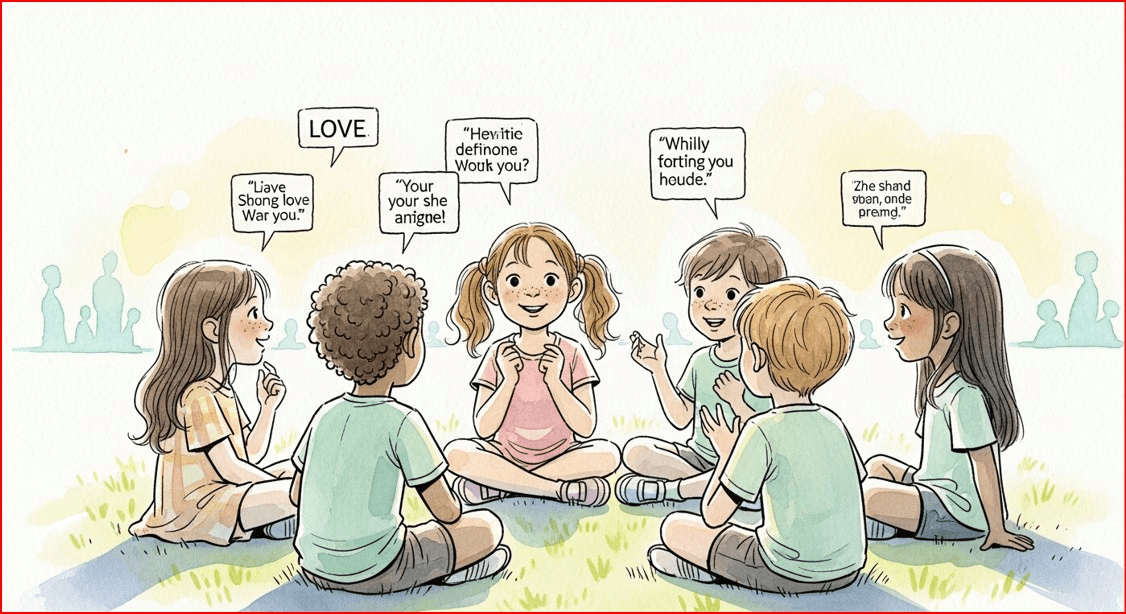
When Children Explain Love: 18 Quotes That Capture What Adults Forget
Ask a child what love means, and you might get an answer that stops you in your tracks.
A group of researchers once posed this simple question to children between 4 and 8 years old. Their responses revealed something remarkable: young children often grasp the essence of love with a clarity that adults spend lifetimes trying to recapture. They see love not as an abstract concept, but as concrete actions, small gestures, and quiet moments of connection.
Here are 18 definitions of love from children that might change how you think about relationships, family, and what really matters.
Love Shows Up in Small Acts of Service
"When my grandmother got arthritis, she couldn't bend over and paint her toenails anymore. So my grandfather does it for her all the time, even when his hands got arthritis too. That's love."
"Love is when my mommy makes coffee for my daddy and she takes a sip before giving it to him, to make sure the taste is OK."
"Love is when Mommy gives Daddy the best piece of chicken."
These children recognize that love lives in the everyday choices we make. It's not grand gestures or dramatic declarations. It's painting someone's toenails when your own hands hurt. It's testing the coffee temperature. It's giving away the best piece of chicken.
Love Changes How We See and Speak to Each Other
"When someone loves you, the way they say your name is different. You just know that your name is safe in their mouth."
"Love is when Mommy sees Daddy smelly and sweaty and still says he is handsomer than Brad Pitt."
"Love is when you tell a guy you like his shirt, then he wears it everyday."
Four-year-old Billy captures something profound: love transforms communication itself. When someone loves you, even your name sounds different. Chris understands that love means seeing past the surface. Noelle knows that love makes us want to please the people who notice us.
Love Provides Safety and Comfort
"During my piano recital, I was on a stage and I was scared. I looked at all the people watching me and saw my daddy waving and smiling. He was the only one doing that. I wasn't scared anymore."
"Love is what makes you smile when you're tired."
"Love is when your puppy licks your face even after you left him alone all day."
Children understand that love creates a sense of safety in an uncertain world. One familiar face in a crowd can dissolve fear. Love energizes us when we're exhausted. It forgives us when we've been absent.
Love Means Staying Connected Through Everything
"Love is when you kiss all the time. Then when you get tired of kissing, you still want to be together and you talk more. My Mommy and Daddy are like that. They look gross when they kiss."
"Love is like a little old woman and a little old man who are still friends even after they know each other so well."
"Love is when Mommy sees Daddy on the toilet and she doesn't think it's gross."
Emily describes the evolution of intimacy with surprising accuracy. Tommy grasps that true love means remaining friends after the mystery fades. Mark, in his own way, understands that love means accepting someone completely, even in unglamorous moments.
Love Requires Presence and Attention
"Love is what's in the room with you at Christmas if you stop opening presents and listen."
Bobby's insight cuts through the materialism that often surrounds holidays. Love isn't in the gifts. It's in the pause between unwrapping them, when you actually notice the people around you.
Love Involves Sacrifice and Generosity
"I know my older sister loves me because she gives me all her old clothes and has to go out and buy new ones."
Lauren recognizes that love sometimes means giving up something you want so someone else can have what they need. Her sister's hand-me-downs represent more than practicality. They represent sacrifice.
Love Transforms How We Treat Others
"If you want to learn to love better, you should start with a friend who you hate."
Six-year-old Nikka offers wisdom that rivals any philosophy text. She understands that love is a skill you can develop, and that the hardest practice yields the greatest growth.
Love Creates Magic in Ordinary Moments
"When you love somebody, your eyelashes go up and down and little stars come out of you."
Karen describes the physical sensation of love with poetic precision. When you're in love, the world literally looks different. Everything sparkles.
Love Needs to Be Expressed
"You really shouldn't say 'I love you' unless you mean it. But if you mean it, you should say it a lot. People forget."
Jessica balances authenticity with generosity. Don't cheapen the words by using them carelessly, but don't hoard them either. People need reminders.
When Words Aren't Enough, Presence Is Everything
Leo Buscaglia, the author and professor known for his teachings on love and human connection, once shared a story that perfectly captures what these children understand.
A four-year-old boy noticed his elderly neighbor crying in his yard shortly after the man's wife had died. The child walked over, climbed onto the grieving man's lap, and simply sat there.
When the boy's mother asked what he had said to comfort their neighbor, the child replied, "Nothing. I just helped him cry."
What Children Teach Us About Love
These children see love clearly because they haven't yet learned to complicate it. They haven't built up layers of cynicism, fear, or self-protection. They recognize love in its purest forms: presence, service, acceptance, sacrifice, and connection.
Adults often search for love in dramatic moments, grand gestures, or perfect words. Children find it in painted toenails, tested coffee, waving hands in a crowd, and sitting quietly with someone who's hurting.
Maybe the question isn't what love means. Maybe it's whether we're still paying enough attention to recognize it when it's right in front of us, doing something as simple as saying our name.
Frequently Asked Questions
Why do children have such profound insights about love?
Children see love in its purest form because they haven't yet developed the layers of cynicism, fear, or self-protection that adults often carry. They observe love as concrete actions and genuine moments rather than abstract concepts, allowing them to identify its essence with remarkable clarity.
What age range shows the most insightful understanding of love?
Children between 4 and 8 years old demonstrate remarkable emotional intelligence about love. This age range represents a sweet spot where children have enough life experience to observe relationships but haven't yet developed the filters that complicate adult perspectives on love.
How can adults learn from children's perspectives on love?
Adults can benefit by recognizing that love often manifests in small, everyday actions rather than grand gestures. Children remind us that love is about presence, service, acceptance, and genuine connection. By paying attention to these simple moments, adults can rediscover the authentic expressions of love they may have overlooked.
What is the most important lesson from these children's quotes?
The most important lesson is that love is demonstrated through consistent, small acts of kindness, presence, and sacrifice rather than dramatic declarations. Whether it's painting someone's toenails despite arthritis, testing coffee temperature, or simply sitting with someone who's grieving, love shows up in the details of daily life.
Who was Leo Buscaglia and why is his story included?
Leo Buscaglia (1924-1998) was an American author, professor, and motivational speaker known as "Dr. Love" for his teachings on human connection and relationships. His story about the four-year-old boy who helped his neighbor cry perfectly illustrates the children's understanding that sometimes love requires nothing more than presence and compassion.

0 Comments
Join the conversation
Be the first to comment
Share your thoughts above.